cocoaFrench
All French lessons
French · Beginner
J'ai perdu mon portefeuille
I lost my walletHero phrasej'ai perdu mon portefeuilleI lost my wallet
A1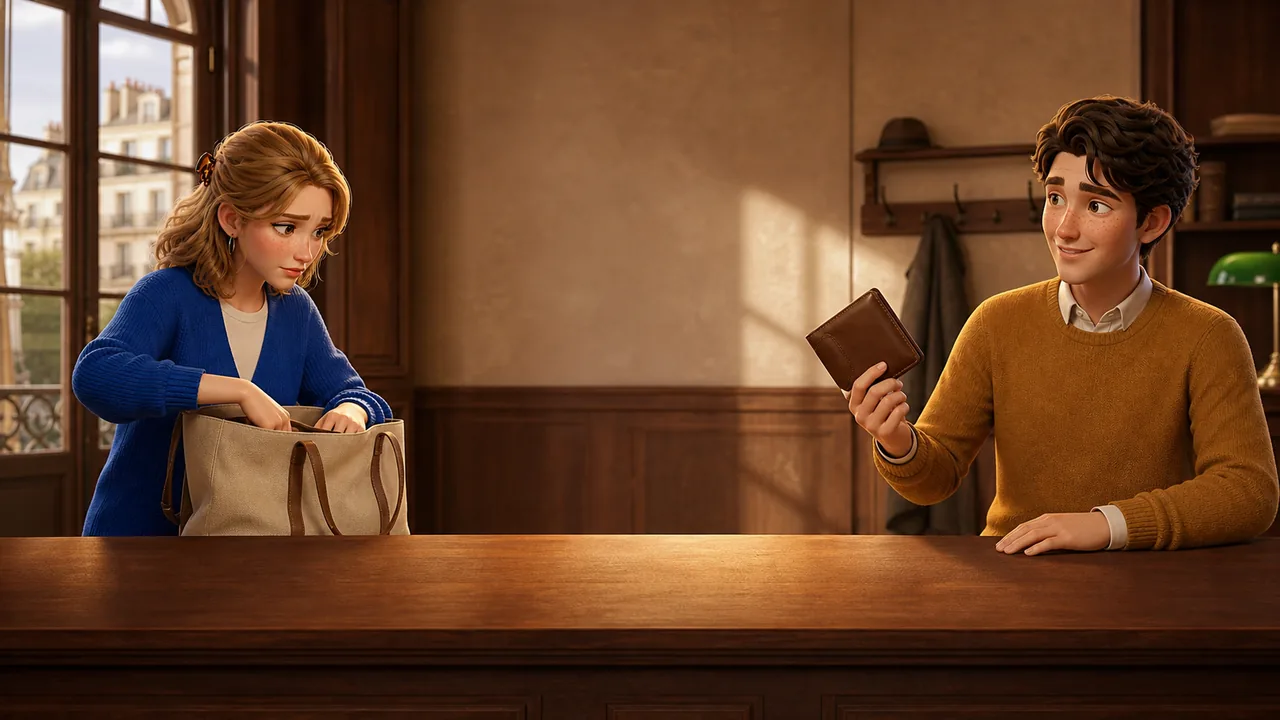 12:05 listen

 Hosted by Léo & Emma
Today you'll learn:
The vocabulary
6 phrases from “J'ai perdu mon portefeuille”
Each phrase has a plain explanation and real lines from the show. Tap “Hear it” to jump to that moment.
j'ai perdu mon portefeuilleHero phrase
I lost my wallet- Quand je ne trouve plus mon argent, je dis : j'ai perdu mon portefeuille.When I can no longer find my money, I say: I lost my wallet.
- La première phrase est : j'ai perdu mon portefeuille.The first phrase is: I lost my wallet.
- Le cœur bat vite, et la personne se dit : j'ai perdu mon portefeuille !The heart beats fast, and the person says to themselves: I lost my wallet!
je cherche partoutPhrase 1
I am looking everywhere- Attendez-moi, je cherche partout !Wait for me, I am looking everywhere!
- La deuxième phrase est : je cherche partout.The second phrase is: I am looking everywhere.
- Passons à notre deuxième phrase : je cherche partout.Let us move on to our second phrase: I am looking everywhere.
au bureau des objets trouvésPhrase 2
at the lost and found officeAt the lost and found office
- Dans une gare, je vais au bureau des objets trouvés.In a station, I go to the lost and found office.
- La troisième phrase est : au bureau des objets trouvés.The third phrase is: at the lost and found office.
- Notre troisième phrase est essentielle : au bureau des objets trouvés.Our third phrase is essential: at the lost and found office.
je décris mon portefeuillePhrase 3
I describe my wallet- Pour aider l'employé, je décris mon portefeuille.To help the employee, I describe my wallet.
- La quatrième phrase est : je décris mon portefeuille.The fourth phrase is: I describe my wallet.
- Passons à la quatrième phrase : je décris mon portefeuille.Let us move on to the fourth phrase: I describe my wallet.
voici ma pièce d'identitéPhrase 4
here is my IDHere is my ID
- Pour prouver mon nom, voici ma pièce d'identité.To prove my name, here is my ID.
- La cinquième phrase est : voici ma pièce d'identité.The fifth phrase is: here is my ID.
- Notre cinquième phrase est indispensable : voici ma pièce d'identité.Our fifth phrase is indispensable: here is my ID.
j'ai retrouvé mes affairesPhrase 5
I found my belongings- Quel bonheur de dire : j'ai retrouvé mes affaires !What a joy to say: I found my belongings!
- Et la sixième phrase est : j'ai retrouvé mes affaires.And the sixth phrase is: I found my belongings.
- Enfin, notre sixième phrase apporte un grand sourire : j'ai retrouvé mes affaires.Finally, our sixth phrase brings a big smile: I found my belongings.
The full conversation
Listen & read along
Emma · now playing
Bonjour à tous et bienvenue ! Salut Léo, comment vas-tu aujourd'hui ?
ShortcutsAPrevious lineDNext lineSReplay this lineRLoop this lineSpacePlay / pause
00:00Intro
Hello everyone and welcome! Hi Léo, how are you doing today?
Hello Emma! I am doing very well, thank you. And you?
I am doing great! Tell me, Léo, have you ever touched your pocket and realized it was empty?
Oh yes! Total panic! You immediately think: you forgot something.
That is true, but you, you always check your pockets ten times before leaving!
Only nine times! But when you find nothing, the stress arrives.
Today, we are talking about a classic situation: lost items.
It is a very useful topic for all beginners.
We are learning six simple expressions, to ask for help calmly.
Today, we are learning six very useful expressions.
The first phrase is: I lost my wallet.
The second phrase is: I am looking everywhere.
The third phrase is: at the lost and found office.
The fourth phrase is: I describe my wallet.
The fifth phrase is: here is my ID.
And the sixth phrase is: I found my belongings.
Six clear phrases to react calmly in every situation.
But before explaining each expression, let us listen to a short story to imagine the scene!
Very good idea, let us discover our story together!
To understand well, let us take a concrete situation. Imagine a classic example at the bakery.
A person orders a warm fresh bread and a croissant.
At the moment of paying for the croissant, disaster!
The person touches their pockets and finds nothing!
The heart beats fast, and the person says to themselves: I lost my wallet!
Total panic! They immediately look for a solution.
The person goes back to the small cafe across the street, where they were sitting.
They look under the table, under the chairs, and check every corner.
They look everywhere with attention, but the table is empty.
Personally, I think one should go see the police, right away, without waiting.
I do not agree, Léo! It is better to search on the spot first.
That is true, you are right, it is more logical to check first.
Then, the cafe waiter gives them good advice.
He advises them to check with the official service.
She then walks toward the lost and found office, in the neighborhood.
Over there, the employee asks calm questions to identify the owner.
The person gives the details, shows their ID, and the employee opens a drawer.
The black wallet was indeed there, brought in by an honest passerby!
What an immense relief to get one's belongings back!
It is a happy and very reassuring ending.
Now, we are going to look at each phrase more closely, to understand well.
Perfect, let us move directly to our detailed explanations!
Let us discover together our phrase of the day: I lost my wallet.
It is the essential phrase, when you can no longer find your money.
In English, it is "I lost my wallet".
The word portefeuille is masculine: we say un portefeuille.
Pay attention to the pronunciation of the final sound: portefeuille. It is soft.
The verb perdre in the passé composé gives: j'ai perdu.
Exactly! The most common formula remains: I lost my wallet.
Let us move on to our second phrase: I am looking everywhere.
The word partout means in all possible places.
In English, it is "I am looking everywhere".
We look on the table, under the sofa, and in the pockets.
We then naturally say: wait for me, I am looking everywhere!
Our third phrase is essential: at the lost and found office.
It is the place where lost items are collected.
In English, it is "at the lost and found office".
In a station or a town hall, we use the formula: at the lost and found office.
It is the safest place to find a lost item.
Let us move on to the fourth phrase: I describe my wallet.
In English, it is "I describe my wallet".
We give the color and the shape, for example: my wallet is black and made of leather.
The clearer the description, the faster the employee checks their lists.
Our fifth phrase is indispensable: here is my ID.
In English, it is "here is my ID".
We use voici to politely present one's passport, or one's card.
It is mandatory to prove one's identity.
Finally, our sixth phrase brings a big smile: I found my belongings.
In English, it is "I found my belongings".
What a joy to say: I found my belongings!
Besides, having a photo of your documents on your phone is very useful!
Exactly! It is an excellent tip to save time.
These six phrases form a complete guide for everyday life.
Now, let us put these phrases into practice in a lively short dialogue!
Excellent idea, let us act out the scene together to practice well!
Hello sir, welcome to the lost and found office. How may I help you?
Hello ma'am. I am worried, because I lost my wallet this morning.
Keep calm sir. Where do you think you left it?
I was sitting near the door. I have been looking everywhere for two hours.
Understood. Can you tell me more about the appearance of this item?
Yes, of course. I describe my wallet: it is brown leather.
Very well. Does it contain documents in your name?
Yes, it contains my bank cards and my transit pass.
One moment please... We actually received a brown wallet this morning!
Wonderful! To verify my identity, here is my ID.
Thank you sir. The photo matches exactly, here is your wallet.
Thank you a thousand times ma'am! I am relieved, I found my belongings!
It is a pleasure to help you, have a great day!
Well done Emma, this example dialogue was very clear and realistic.
Thank you Léo! Politeness helps resolve many situations.
Now, let us test our listeners' memory with six practical situations!
Here we go, let us see how to react in each situation!
Situation number one: you are on the metro and your pocket is empty. What do you say with worry?
I look around me and I say: oh no, I lost my wallet!
Very good! That is the perfect reflex to express the problem.
Situation number two: you checked your coat, your bag, and your desk. Which phrase summarizes your action?
I take a breath and explain to my friends: I am looking everywhere since this morning.
Exactly! The word partout shows that you searched well.
Situation number three: nobody has seen your item at the restaurant. Where do you decide to go to ask for help?
I ask the staff, then I go to the lost and found office.
Perfect! That is the most effective approach in a big city.
Situation number four: the reception agent asks for the color, and the shape of your item. What do you do?
I stay very precise and I say: I describe my wallet carefully.
Bravo! Precision avoids identification mistakes.
Situation number five: the employee wants to verify your name before returning the item. What do you present to them?
I take out my passport and say politely: here is my ID.
Great! That is the indispensable proof to reclaim one's wallet.
Situation number six: everything is in order, and you hold your wallet in your hands. What joyful phrase do you say?
With a huge smile, I exclaim: finally, I found my belongings!
Wonderful! Six correct answers out of six, congratulations Léo!
Thank you Emma! This practice makes memorizing the phrases stress-free.
Before finishing our episode, let us do a quick review of our six expressions.
Excellent idea, let us summarize everything together to anchor the words!
We now arrive at our quick review.
First phrase: I lost my wallet.
Second phrase: I am looking everywhere.
Third phrase: at the lost and found office.
Fourth phrase: I describe my wallet.
Fifth phrase: here is my ID.
And sixth phrase: I found my belongings.
There are our six key expressions perfectly summarized!
Here is now your speaking challenge of the day: your turn to speak!
Tell us in the comments: have you ever lost a valuable item while traveling?
Write your answer in simple French, with a phrase of the day!
We always read your comments with great pleasure.
Thank you everyone for listening, take good care of your belongings!
See you very soon for a new episode of easy French! Goodbye!
Goodbye and until next time!
À toiYour turn
S’entraîner avec 6 vraies situationsPractice with 6 real situations
1j'ai perdu mon portefeuilleI lost my wallet
Tu es dans le métro et ta poche est vide. Que dis-tu ?
You are on the metro and your pocket is empty. What do you say?2je cherche partoutI am looking everywhere
Tu as vérifié ton manteau, ton sac et ton bureau. Que dis-tu ?
You checked your coat, your bag, and your desk. What do you say?3au bureau des objets trouvésat the lost and found office
Personne n'a vu ton objet au restaurant. Où vas-tu ?
Nobody has seen your item at the restaurant. Where do you go?4je décris mon portefeuilleI describe my wallet
L'agent te demande la couleur et la forme de l'objet. Que dis-tu ?
The agent asks you for the color and the shape of the item. What do you say?5voici ma pièce d'identitéhere is my ID
L'employé veut vérifier ton identité. Que présentes-tu ?
The employee wants to verify your identity. What do you present?6j'ai retrouvé mes affairesI found my belongings
Tu as récupéré ton portefeuille. Quelle phrase joyeuse dis-tu ?
You got your wallet back. What joyful phrase do you say?Today's small task
Racontez-nous en commentaire : avez-vous déjà perdu un objet précieux en voyage ?Tell us in the comments: have you ever lost a valuable item while traveling?
All languages · cocoaReview page for J'ai perdu mon portefeuille